
Editor’s note: We would like to thank Rachel Rodriguez, University of Louisville, Louisville (Kentucky), for providing this piece. To contact the author, please email Rachel Rodriguez. If you would like to share your writing center’s experience during COVID-19, please submit via WLN.

Rachel Rodriguez
If I’m honest, when news came that this year’s Dissertation Writing Retreat would be going virtual, my heart sank. Not because I didn’t want to tutor it, but because I did. For the first time in my experience as a writing consultant, I was absolutely positive I’d be an awful tutor.
Going virtual wasn’t precisely the problem; I had tutored online before. While this year’s retreat would certainly feel different than past ones, I was reasonably confident in my ability to assist my writers via video chat. The problem was, going virtual meant working from home.
Home, for me, looked like the bizarro world of what it had been a few months prior. Instead of books littered all over my apartment, there were burp cloths. In February I had given birth to my first child. Complications sent both of us briefly into intensive care, and we were home as a family for less than two weeks before self-quarantine began in my state. COVID-19 meant a long-awaited visit from my in-laws, strategically timed for childcare coverage during the retreat, had been cancelled. My husband, a dental hygienist, was already back at work sweating under seemingly endless layers of PPE. That meant we were on Plan Z – tutoring from home with a three month old.
I was riddled with anticipatory guilt, certain I’d be distracted, scatterbrained, unhelpful. I went into the retreat with my jaw clenched, promising baby all his favorite things (baths, his mobile, milk) if he’d just take the longest naps ever that week.
I’d like to say that he listened dutifully, but I’d be lying. In fact, he seemed crankier than ever. He didn’t seem to understand why I was talking for hours to a box and not to him. But by the end of the first day of the week-long retreat, I realized something: no one’s life is normal right now. One of my writers was working in a studio shared with their significant other, a healthcare worker. Another writer’s microphone kept acting up, necessitating computer reboots. One day, my writer and I both had the noise of maintenance men to contend with. Both of my writers’ research projects had been impacted by the pandemic. Plans for focus groups, interviews, and observations had to be hastily revised. This meant they were writing the most high-stakes document of their academic careers with not quite the data sets they had planned on, adding to their stress. We talked about COVID-19 amidst our talk about writing. Should they write about the pandemic, to justify their methodological changes? Should they adjust their completion timelines?
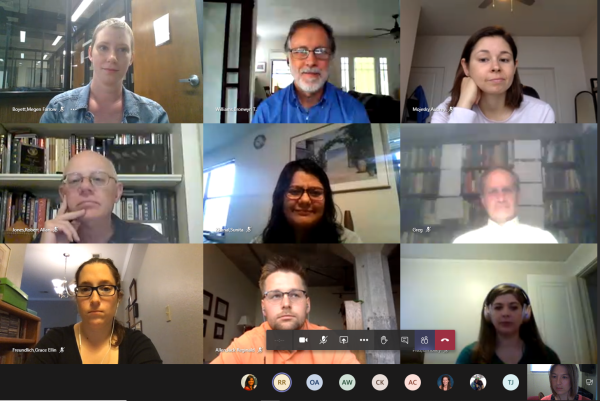
We “made it work.”
I may not have exactly tutored with all the thoughtful, receptive vigor I like to think I usually do, but to quote Tim Gunn from Project Runway (my pandemic escapist TV of choice), we “made it work.” We consulted via Microsoft Teams, which all students at my institution have access to, eliminating the need for logins or accounts. We uploaded files there, and took meeting notes. Writers would share their screen while they brainstormed, outlined, or revised, maintaining ownership over their work. Teams even enhanced our experience with features like blurring backgrounds and muting audio (read: fussy baby) while reading work aloud. All the while, healthcare workers slept in the background, plumbers worked, roofs were built, and dissertation progress was made.
My favorite moment was during a workshop I held. I apologized in advance to the group for any infant interruptions, gesturing with a harried smile at the little brown head poking through the carrier I wore. One of the participants told me she too was a dissertating mother, and I was grateful for her camaraderie. Later, her consultant told me that I came up in their conversation, and that the writer felt less alone seeing me successfully juggle new motherhood and dissertating during a pandemic. My first thought was that I certainly didn’t feel successful, but, upon reflection, I decided that I likely needed to redefine with immense self-forgiveness what constituted “success” right now. In the end, a week I thought would be defined by chaos was instead defined by patience, grace, and empathy. No matter the circumstances, these are the emotions that resonate in every writing consultation.


Leave a Reply